How Tower Rush Actually Works — The Timing Mechanic Explained

People ask if Tower Rush is skill or luck. Here's the honest answer after tracking 200 rounds of my own gameplay: both. And the ratio shifts depending on which floor you're on.
The timing is skill. Period. Whether you land that block flush on the tower or leave it overhanging -- that's your hand-eye coordination, your read on the crane speed, your feel for the rhythm. The bonus floor triggers and multiplier values per floor? RNG. You can't control those. But whether you LAND that floor? That's on you.
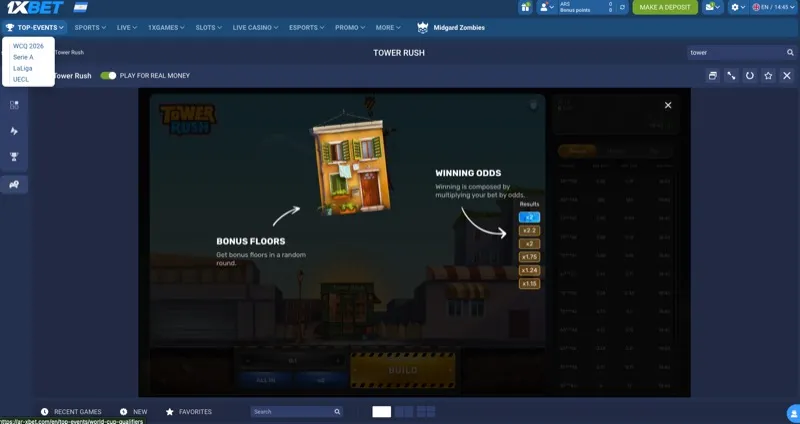
The Core Timing Mechanic
How the Crane Works
When you click Build, a crane appears above your tower. It swings a block left and right, pendulum-style. The block moves across the full width of the tower. You tap or click to drop it. Where the block is when you tap determines everything.
Three Possible Outcomes Per Drop
- Perfect drop: Block lands flush on the tower. Tower stays stable. The crane maintains its current speed on the next floor. Multiplier for this floor gets added to your compounding total. This is what you're aiming for every single time.
- Offset drop: Block overhangs to one side. Tower wobbles visibly. The floor still counts -- you still get the multiplier. BUT the crane swings FASTER on the next floor. One offset makes every future drop harder. Two offsets? The crane is basically flying. Three? You're guessing.
- Miss: Block falls off the tower completely. Tower collapses. Bet is lost. Game over for this round.
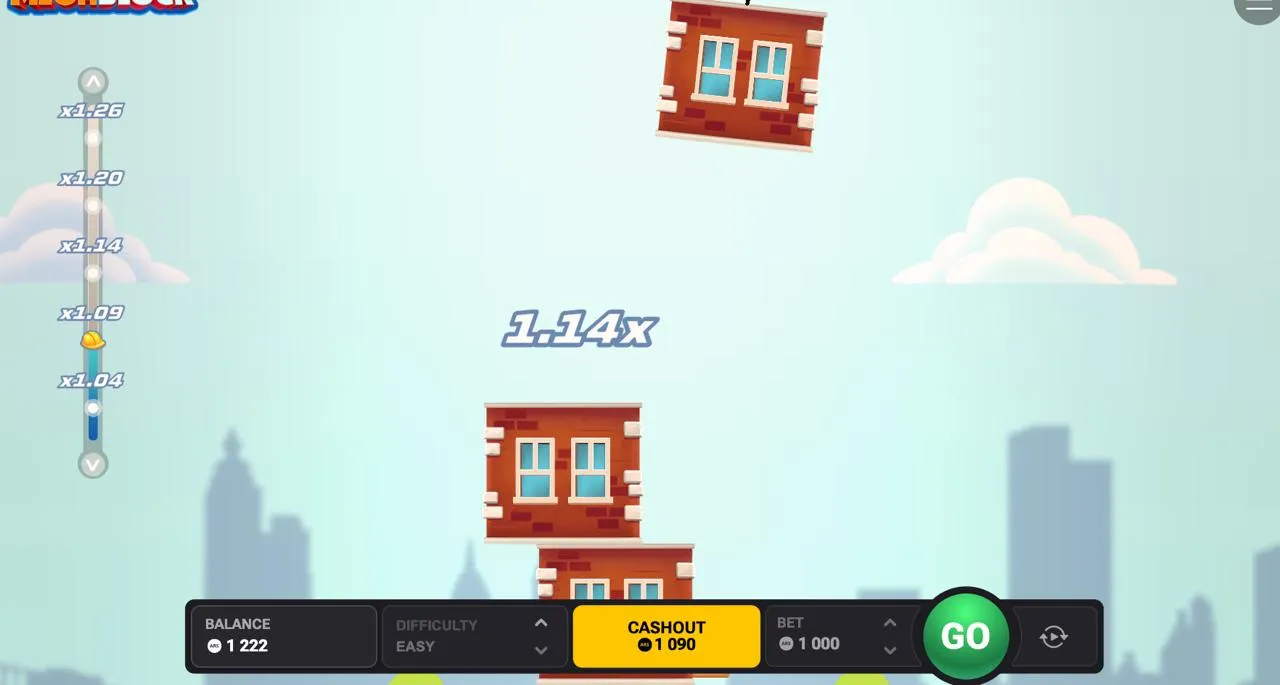
The Offset Cascade -- Why Timing Is the Core Skill
This is the part nobody explains well. One bad drop doesn't just wobble your tower. It speeds up the crane. And a faster crane means your NEXT drop is harder to time. Which means you're more likely to offset again. Which speeds up the crane MORE.
I tracked my placement accuracy over 200 rounds. Perfect drops: 62%. Offset: 28%. Collapses: 10%. But here's the thing -- almost every collapse came after at least one offset. The offset-to-collapse pipeline is real. Out of 20 collapses, 17 were preceded by at least one offset in the same round. Only 3 were clean misses on a slow crane.
Note: Based on personal play sessions. Small sample size — your results will vary. Not scientific data.
| Floor | Crane Speed (if all perfect) | Crane Speed (after 1 offset) | My Drop Accuracy |
|---|---|---|---|
| 1 | Slow | Slow | 89% |
| 2 | Slow | Medium | 81% |
| 3 | Slow-Medium | Fast | 72% |
| 4 | Medium | Very Fast | 58% |
| 5 | Medium | Insane | 41% |
| 6+ | Medium-Fast | Nearly Impossible | 23% |
Look at that accuracy drop-off. Floor 1 I'm hitting 89%. Floor 6+ I'm down to 23%. And that's with ALL perfect drops up to that point. If I've had an offset earlier, those numbers are even worse because the crane is already speeded up.
How Multipliers Compound
Each floor generates its own multiplier value via the RNG. These aren't fixed -- floor 1 could be x0.4 or x2.7 or x0.8. Every round is different.
The multipliers COMPOUND (multiply together, not add). So if you build 4 floors with multipliers x0.4, x1.5, x4.3, and x2.0, your total is: bet x (0.4 x 1.5 x 4.3 x 2.0) = bet x 5.16.
This means a single high-multiplier floor can rescue a round that started with a lousy x0.4. And it means the payoff for reaching higher floors can be massive -- if you can actually land them.
The Provably Fair System
What's RNG and What's Skill
Here's the split:
- RNG (you can't control): Multiplier value for each floor. Bonus floor triggers. Which type of bonus floor appears.
- Skill (you CAN control): Whether the block lands flush, offset, or misses. When to cash out vs keep building.
How to Verify a Round
Galaxsys built Tower Rush on a provably fair system using hash + seed verification.
- Click the shield icon in the game interface.
- Copy the key and salt values shown for the round.
- Paste them into any third-party SHA256 hash checker.
- The hash should match what was displayed before the round started.
This proves the RNG components (multiplier values, bonus triggers) were determined before you played. The casino can't change them after the fact. Your timing -- the skill component -- isn't part of the hash because it happens in real-time during your interaction with the crane.
Is It Skill or Luck? The Real Answer
People want a clean answer. They don't get one.
Floor 1-2: mostly skill. The crane is slow. If you have decent reflexes, you'll land these. The RNG only determines how MUCH the floor is worth.
Floor 3-4: equal parts skill and luck. The crane is medium speed. Your timing matters but the margin for error is shrinking. Whether you get a bonus floor here is pure luck and can change your entire round.
Floor 5+: mostly luck. The crane is so fast that even good players are essentially guessing. And if you've had any offsets, forget it. The crane is flying. You're praying.
So early floors reward skill. Late floors are closer to gambling. Which is exactly why the smart strategy is to cash out at floors 2-4 unless you've had all perfect drops or a Frozen Floor.
The 3 Bonus Floors -- Deep Dive
Frozen Floor (The Game-Changer)
A block covered in ice. Appears randomly as a special block. If you land it successfully, your current winnings are LOCKED. Even if every future floor collapses, you keep the frozen amount. Only 1 per round.
This changes everything. Before a Frozen Floor, every "Build" decision is risking your entire stack. After a Frozen Floor, every "Build" decision is pure upside. You literally can't lose what's been frozen.
My data: in rounds where I got a Frozen Floor, my average payout was x6.2. In rounds without one, my average was x2.1. Frozen Floor doesn't just protect your money -- it changes your behavior. You play more aggressively (correctly) because there's no downside.
Temple Floor
A rare temple-shaped block. Landing it triggers a bonus wheel with 10 sections: x1.5, x2, x3, x5, x7, or another Freeze. Can appear multiple times per round.
Sounds amazing on paper. In practice, the wheel usually lands on x1.5 or x2 -- the low-value sections make up about 60% of the wheel. The x7 hit rate is maybe 5-8%. Don't change your cashout plan just because you got a Temple Floor. Take whatever the wheel gives you and keep making the same cashout decision you would've made otherwise.
Triple Build
Automatically places 3 floors with perfect drops. Each floor gets minimum x1 multiplier. Bypasses the timing challenge entirely for 3 floors.
Free floors. Free multipliers. No timing risk. Always a gift. The only thing to know is that the x1 minimum multiplier per floor means Triple Build floors contribute less to your compounding total than a natural high-multiplier floor. But since they're FREE and PERFECT, who cares.
Want to practice the timing before betting real money?
Play Tower Rush Demo at 1xBet →RTP and House Edge
Official RTP: 95.1-97.6%. That range exists because YOUR strategy affects the effective RTP. Early cashout players (floors 2-3) see the higher end. Players who push for floor 7+ face more collapses and land at the lower end.
The house edge is built into the multiplier distribution -- floor multiplier values average slightly below what would make the game perfectly fair. Plus the crane acceleration mechanic naturally pushes collapse rates up as towers get taller, which benefits the house.
But here's what makes Tower Rush different from pure RNG games: your timing DOES affect your personal RTP. A player with 80% perfect drop rate will have a meaningfully higher effective RTP than a player with 50% accuracy. Skill matters. Not enough to guarantee profit. But enough to shift the odds.
How to Get Started
- Register on 1xBet and find Tower Rush in the casino section
- Start in demo mode -- practice the timing for at least 20 rounds
- Read the strategy guide for cashout timing and bonus floor tactics
Ready to learn the strategies?
Read Full Strategy Guide